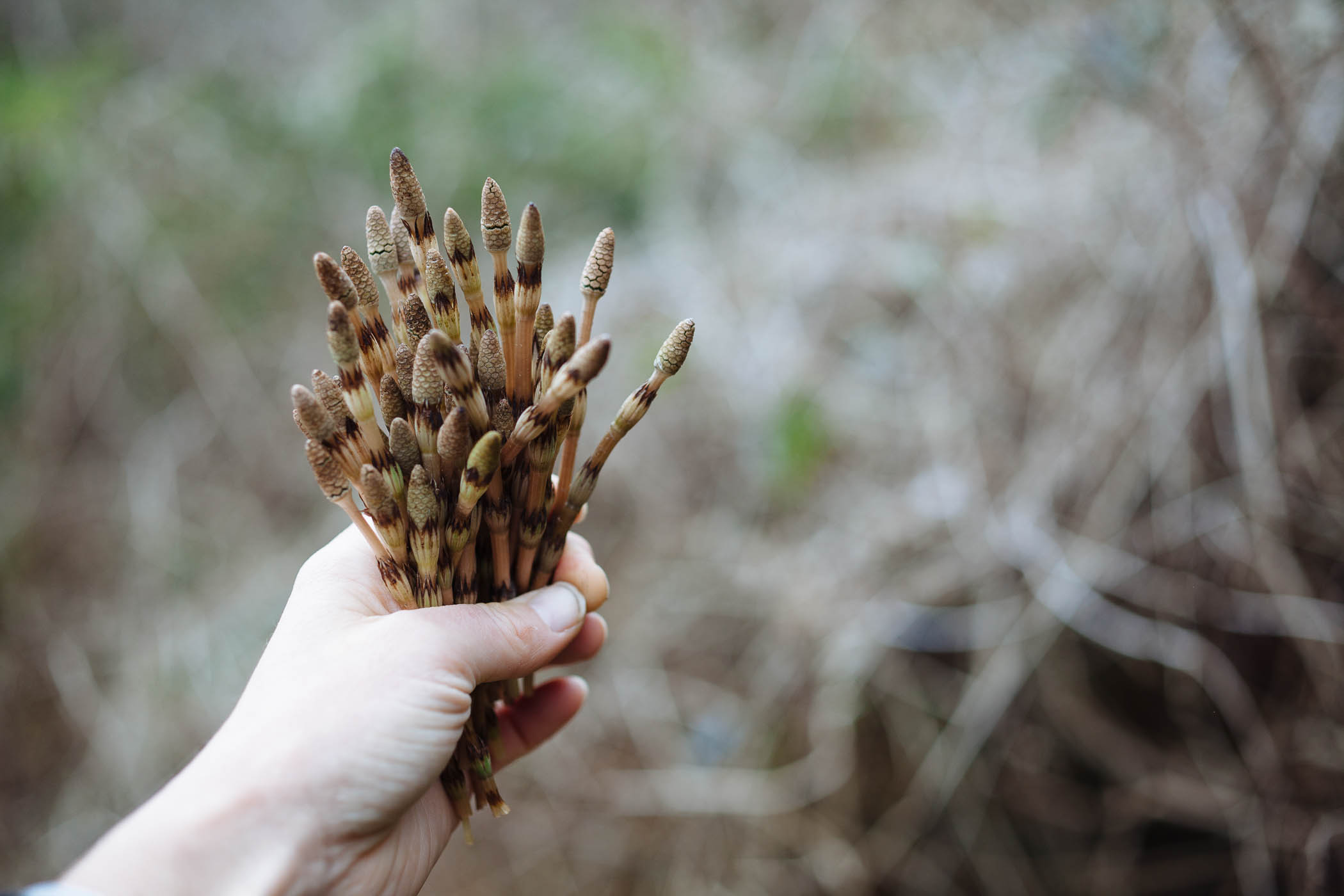
From February through May, I follow the unfolding of sansai, wild mountain edibles — as they rise in sequence from the slowly warming earth. Fukinoto. Tsukushi. Warabi. Takenoko. Each one arrives with its own temperament, its own window, its own invitation.
What once felt like a hunt now feels like recognition. I know these hillsides differently now. Not as terrain to search, but as something closer to a vast, untamed garden — one that reveals itself only to those who return, again and again, with attention. There was a time when we gathered horsetail along the edges of rice paddies, until fences went up to keep wild boar at bay. We lost that place. But the hills are generous. They offered others.
Now I know where tsukushi emerge first. Which slopes warm earliest. Which roadside edges hold the plumpest shoots. Still, these are not things one speaks of too freely. Some knowledge is held, not shared.
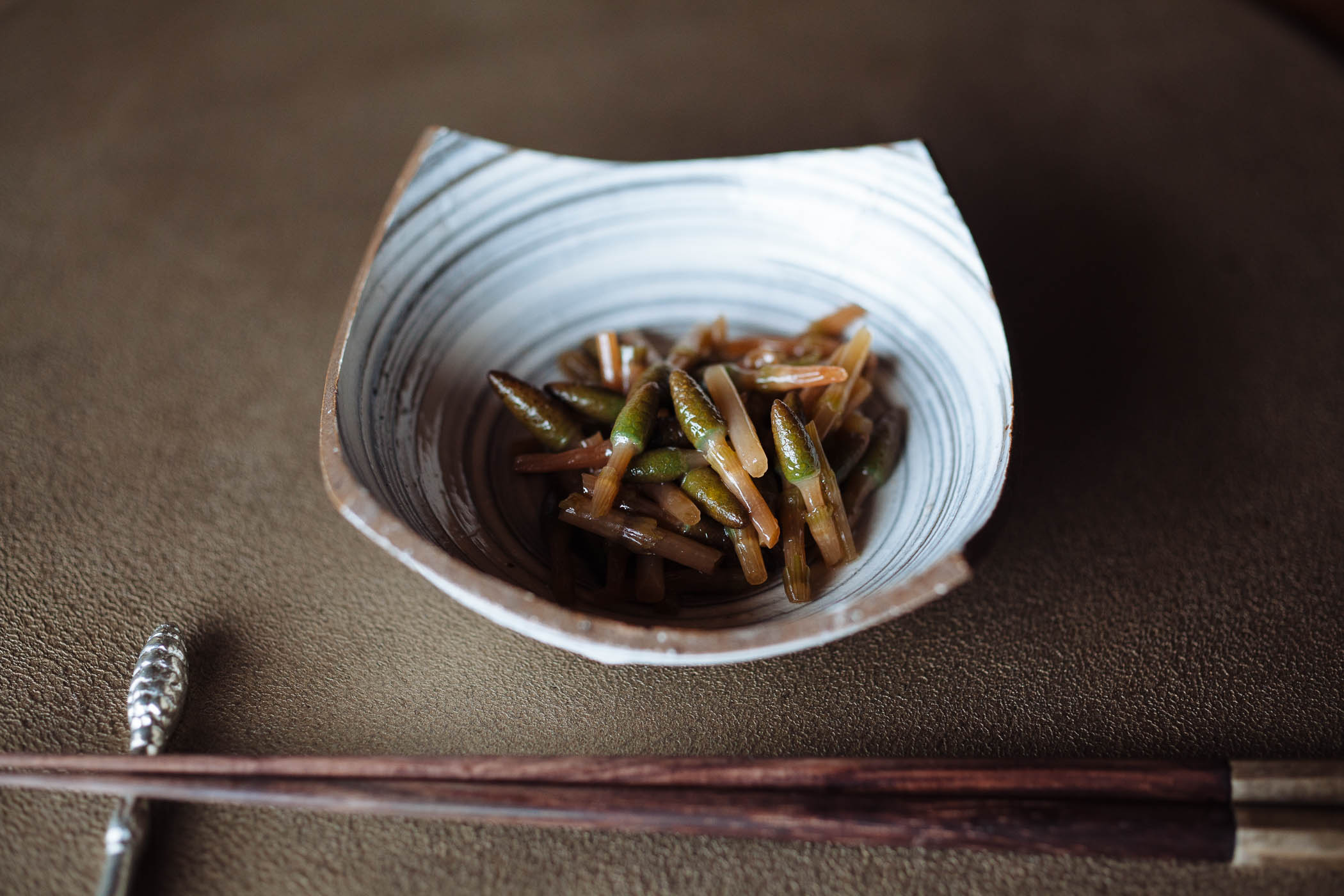
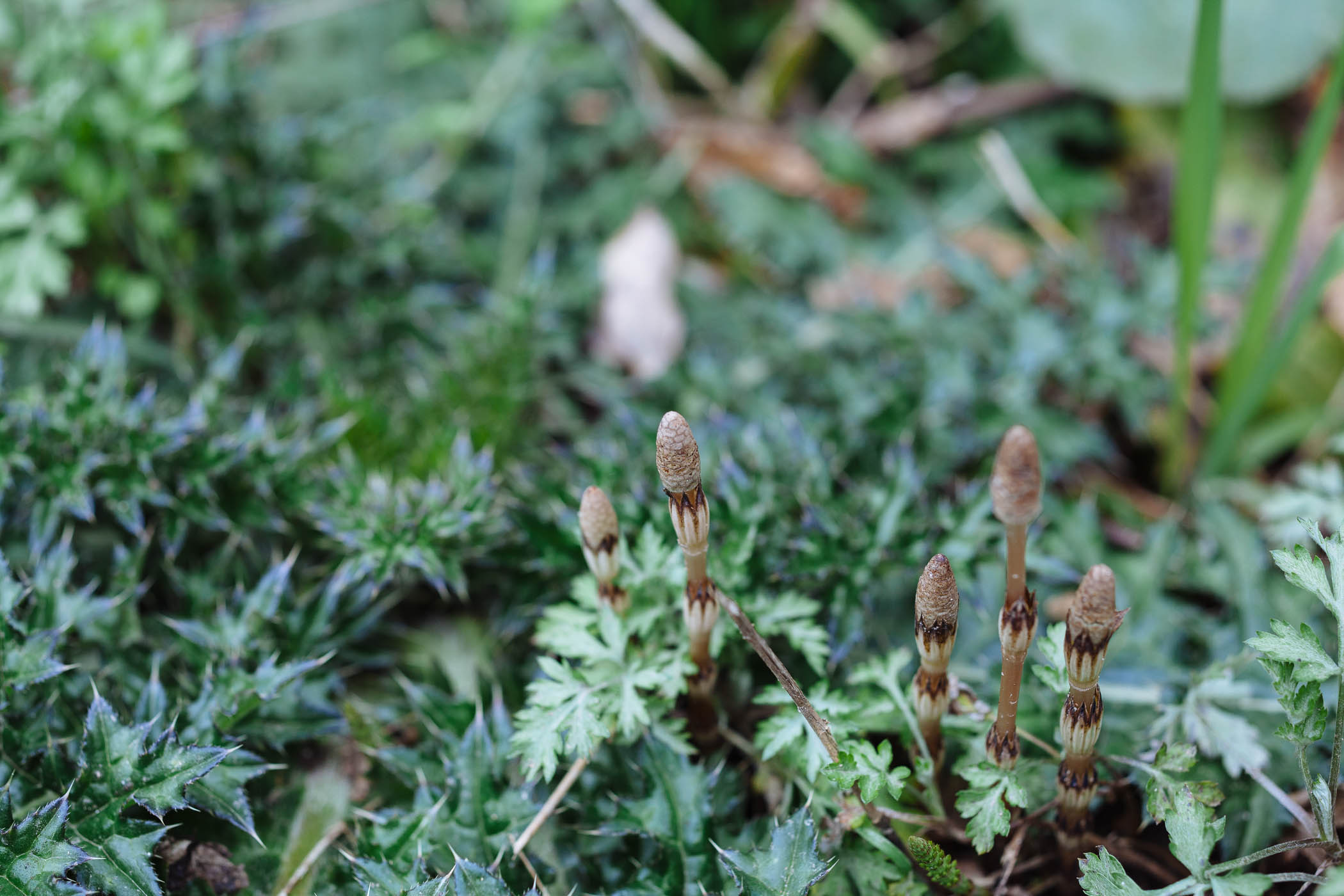
Tsukushi — the fertile shoots of field horsetail — feel almost ancient in the hand. Prehistoric, even. They rise from the soil in pale tones of pink and beige, each stalk ringed with delicate paper sheaths, hakama, like the layered garments worn over kimono.
To eat them, each must be stripped bare. There is no clever shortcut. No efficient method. You sit, and you begin. One by one, the hakama are removed — a slow undoing. A quiet unraveling. At first, the mind resists. But then something shifts. The hands continue, steady and repetitive, while the mind loosens its grip. It wanders. It drifts. It settles into that familiar, fertile space between doing and being — like painting a wall, like swimming long, unhurried laps. The body is occupied. The mind unbound. And in that space, something reveals itself.
As I worked through a basket of tsukushi the other day, I found myself circling a tension I know well — one I return to again and again: The pull between thrill and comfort. I crave both with equal intensity. The unfamiliar, the electric, the not-yet-known — and also the deeply familiar, the steady, the reassuring. I become restless when one overtakes the other. And yet, the things that root me most deeply are often the same things that ignite me. Foraging. Harvesting ume from the orchard. Pulling vegetables from soil I have turned with my own hands. These acts live at the intersection — where anticipation meets recognition, where uncertainty gives way to quiet knowing. Each season offers the same arc: hope, then search, then finding, and finally, that soft exhale of yes, here it is again.
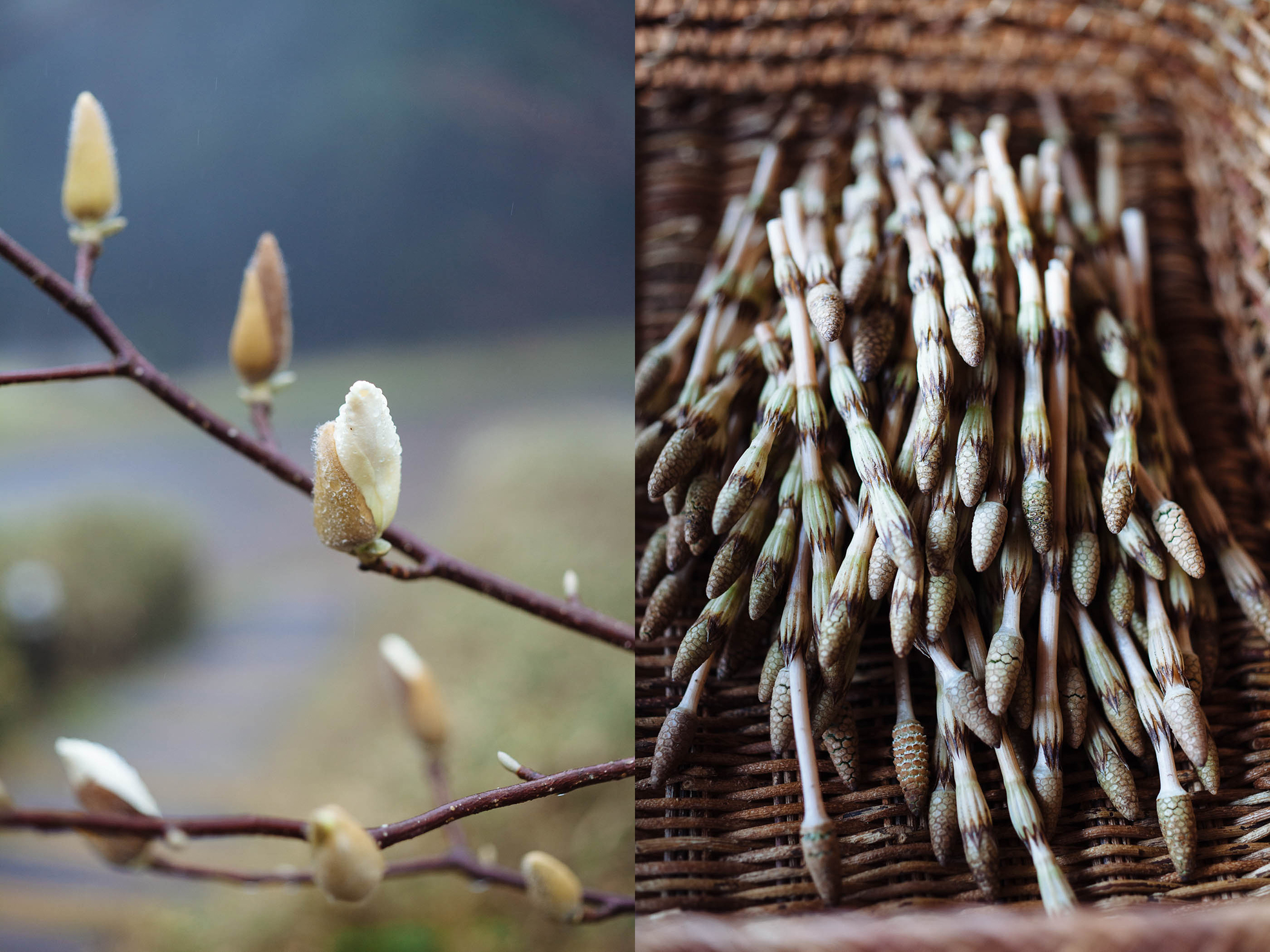
Foragers do not easily reveal their wild gardens. But if you come, I will take you. We will walk the hills together and gather what the season offers — handfuls of what others might overlook, what grows unbidden, what insists on being found. And then we will return to the kitchen and transform it.
If the tsukushi are still tightly closed, their small conical heads hold the greenest of spores, bitter, vibrant, alive. We will blanch them, then fold them into soft eggs warmed gently in sesame oil, seasoned simply with soy and salt.
Or we will prepare them as ohitashi. Ohitashi is a quiet dish. A restrained one. Its name comes from hitasu, to soak. Vegetables are blanched, then steeped lightly in a broth of dashi and soy, sometimes lifted with a trace of mustard, a flicker of vinegar, a sheen of sesame oil. Nothing is added to obscure. Only to enhance and reveal. It is a practice in restraint. The vegetables must remain themselves. They must yield, but never lose themselves.
If we pay attention, if we gather with care, cook with restraint, and eat in the company of others who know how to receive, then something opens.
Thrill and comfort collapse into one another. The wild becomes familiar. The familiar becomes alive again. And the table, simple, seasonal, shared, becomes a place where nothing is missing.